
Beyond the Browser
What Changes When AI Acts on Atoms, Not Pixels

I remember watching WALL-E in ‘08 and wondering what the world would look like if or when robots moved from fiction into everyday life. Nearly two decades later, having a front-row seat as an investor in this transition has been genuinely inspiring - especially when thinking about all that I dreamed up about as a kid.
Physical AI (the application of AI to machines that perceive, reason, and act in the physical world) has become a defining theme over the last 2-3 years. Robotics as a category has raised a record ~$42B in 2025, ~9% of global venture funding. The momentum continued in 2026 - Skild AI raised $1.4B, Apptronik expanded its Series A to more than $935M, and Bedrock Robotics raised a $270M Series B.
Aside from $, the stronger signal is the level of deployments we’ve seen in the market. Figure says its robots worked 10-hour shifts at BMW and contributed to 30K+ vehicles (Figure). Agility Robotics says Digit has moved more than 10K+ totes at GXO, the logistics provider (Agility). Mind Robotics is targeting manufacturing, Dexory is building warehouse intelligence, Watney Robotics is working in data centers, and Multiply Labs is automating cell-therapy manufacturing. Robots aren’t just going commercial, but also vertical.
Why this moment feels different
Robotics has produced impressive demonstrations for decades (throwback to Sony’s companion dog - ERS 1000). What changed is the convergence of several curves:
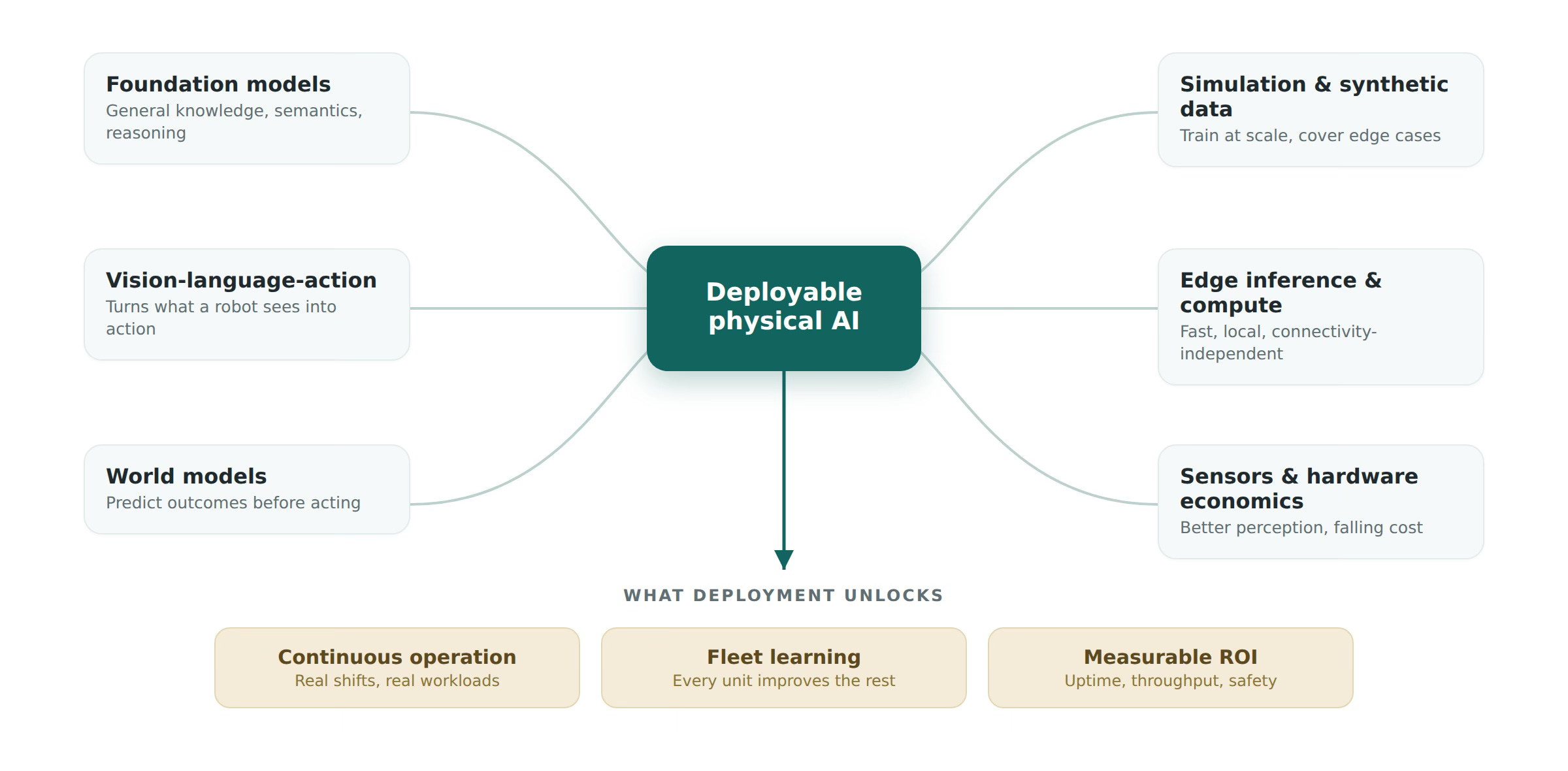
Foundation models: Give robots general knowledge, semantic understanding, and reasoning capabilities → reduce need to program every task or environment from scratch
Vision-language-action (VLA) models: Connect what a robot sees + what a person asks to execute on physical action to complete tasks
World models: Help robots predict how objects, people, and environments will respond before they act → enabling better planning over longer and more complex tasks
Simulation and synthetic data: Allow robots to practice / train at scale and encounter edge scenarios → reduce cost, time, and risk of collecting every experience in the real world
Edge inference and on-device compute $: Moves decision-making onto the robots → allowing for improved speed, reliability, privacy, and ops in environments with limited connectivity (e.g., construction, mining, space?)
Sensors, actuators, and hardware economics: Better perception, more precise movement, and falling cost of components → making robots more capable and affordable for commercial deployments
With that, the key shift now is that the bottleneck is moving from raw intelligence to deployment. When talking to founders, a lot of the focus is now being centered around reliability, safety, workflow integration, field service, and customer ROI. A robot that works 90% of the time may be an extraordinary demo, but an unusable production system.
That insight shaped our investment in Bedrock Robotics. In construction, autonomy is shifting from building smarter individual machines (e.g., tele-ops) to building the operating system for the entire jobsite. Drawing on their experience at Waymo, Bedrock’s team is building an autonomy platform that runs across existing equipment, learns from real production environments, and helps customers complete work more safely and efficiently.
The next data flywheel
The first AI era was built mainly on static, human-generated corpora. Physical AI adds continuous experience: sensor streams, human demonstrations, tele-ops, robot trajectories, interventions, failures, recoveries, and simulation-generated scenarios - a lot driven from the key unlocks noted above.
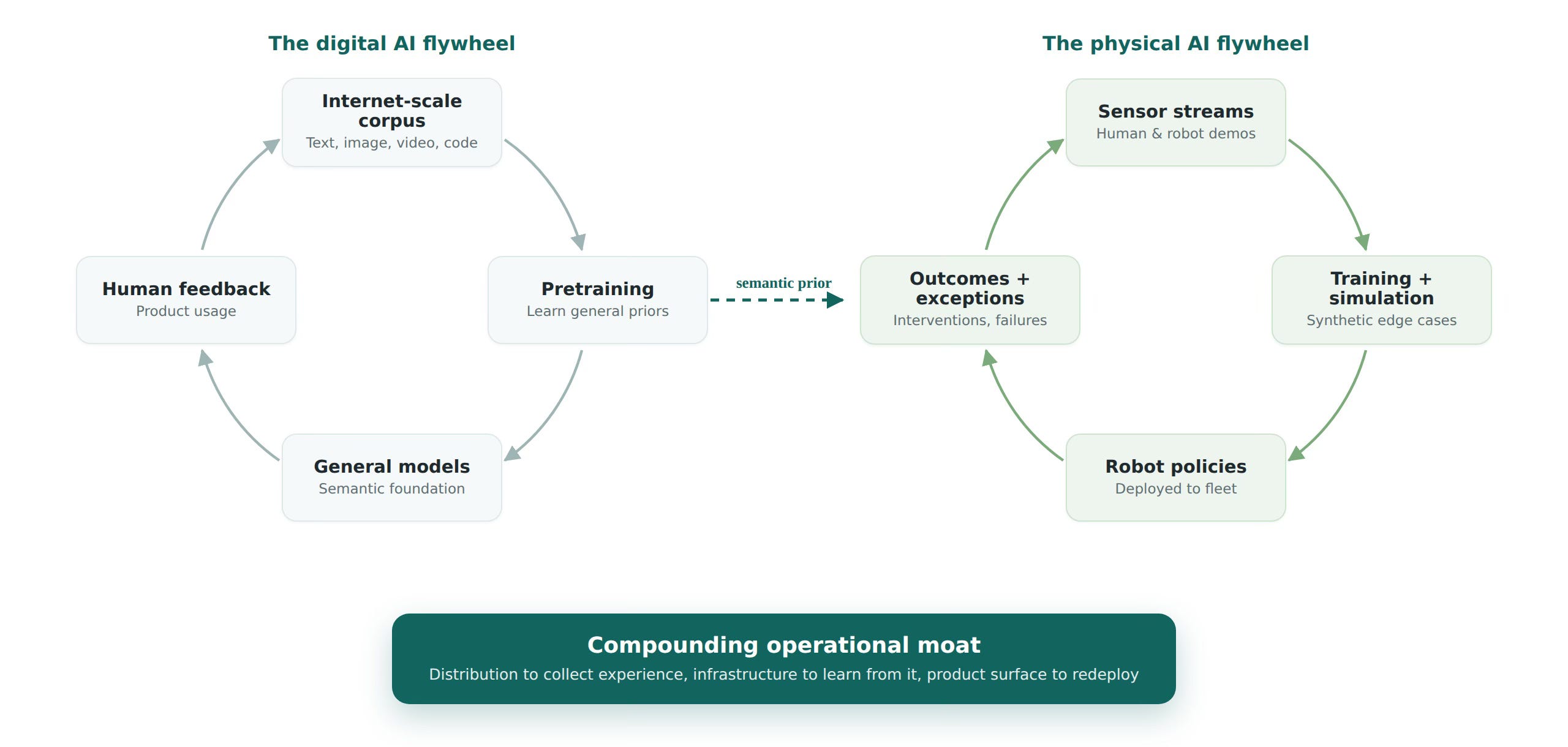
Therefore, the deployed machine becomes both a product and a data-collection node. As mentioned by Rebecca over at Union Square Ventures, immediate control happens at the edge. Training, simulation, analytics, and fleet management happen centrally. Each deployment can improve the rest of the fleet.
Similar to what conversations have been about in enterprise applications, the moat isn’t a model checkpoint, but more so about proprietary operational experience, plus the distribution and infrastructure required to turn that experience into better policies. As base models become more accessible, experience at the edge compounds.
Mapping the market
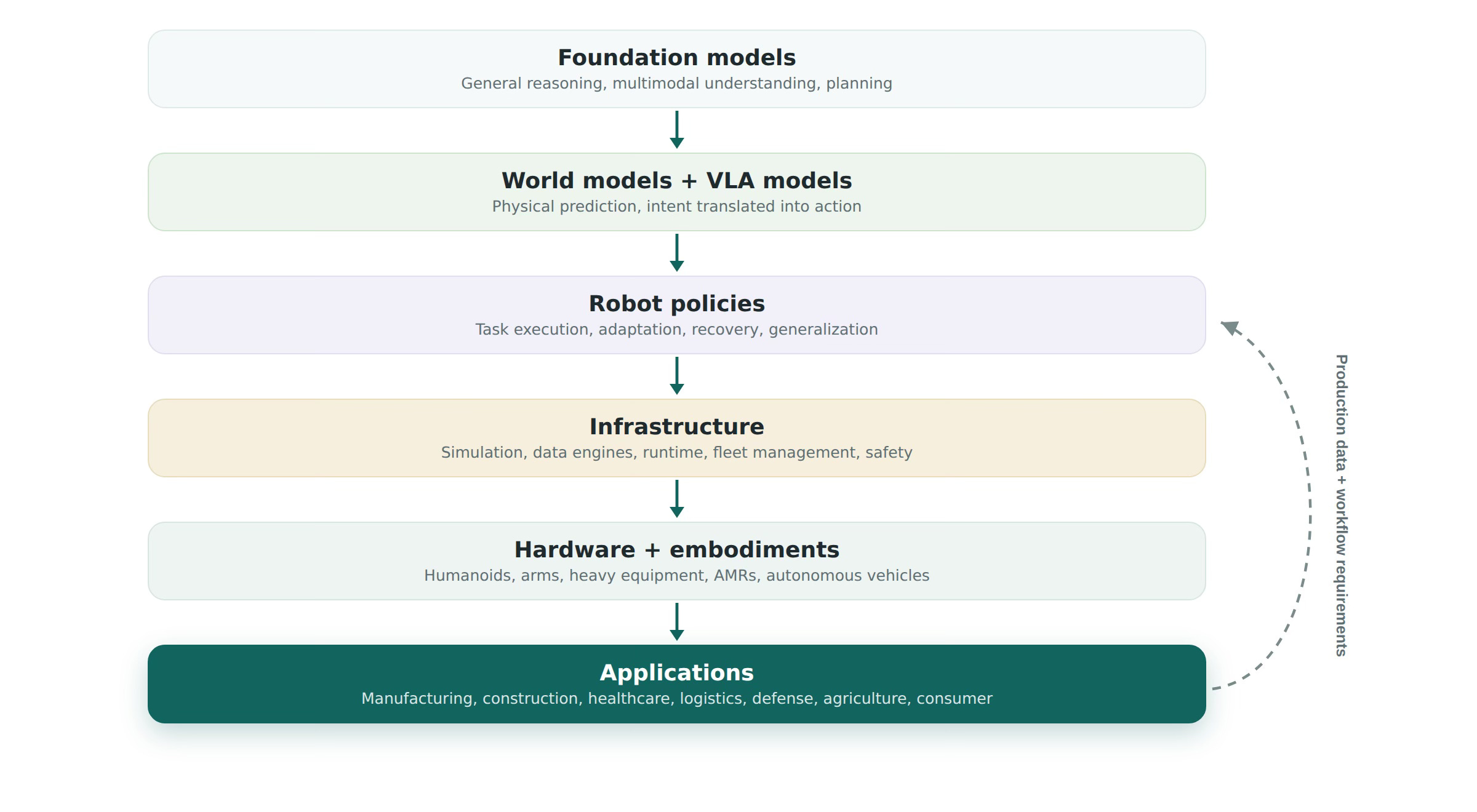
The stack spans models, robot policies, simulation and fleet infrastructure, hardware, applications, and field operations. Frontier labs are taking different approaches. Google DeepMind is productizing embodied reasoning through Gemini Robotics. OpenAI has rebuilt an internal team spanning the model stack, hardware, and software.
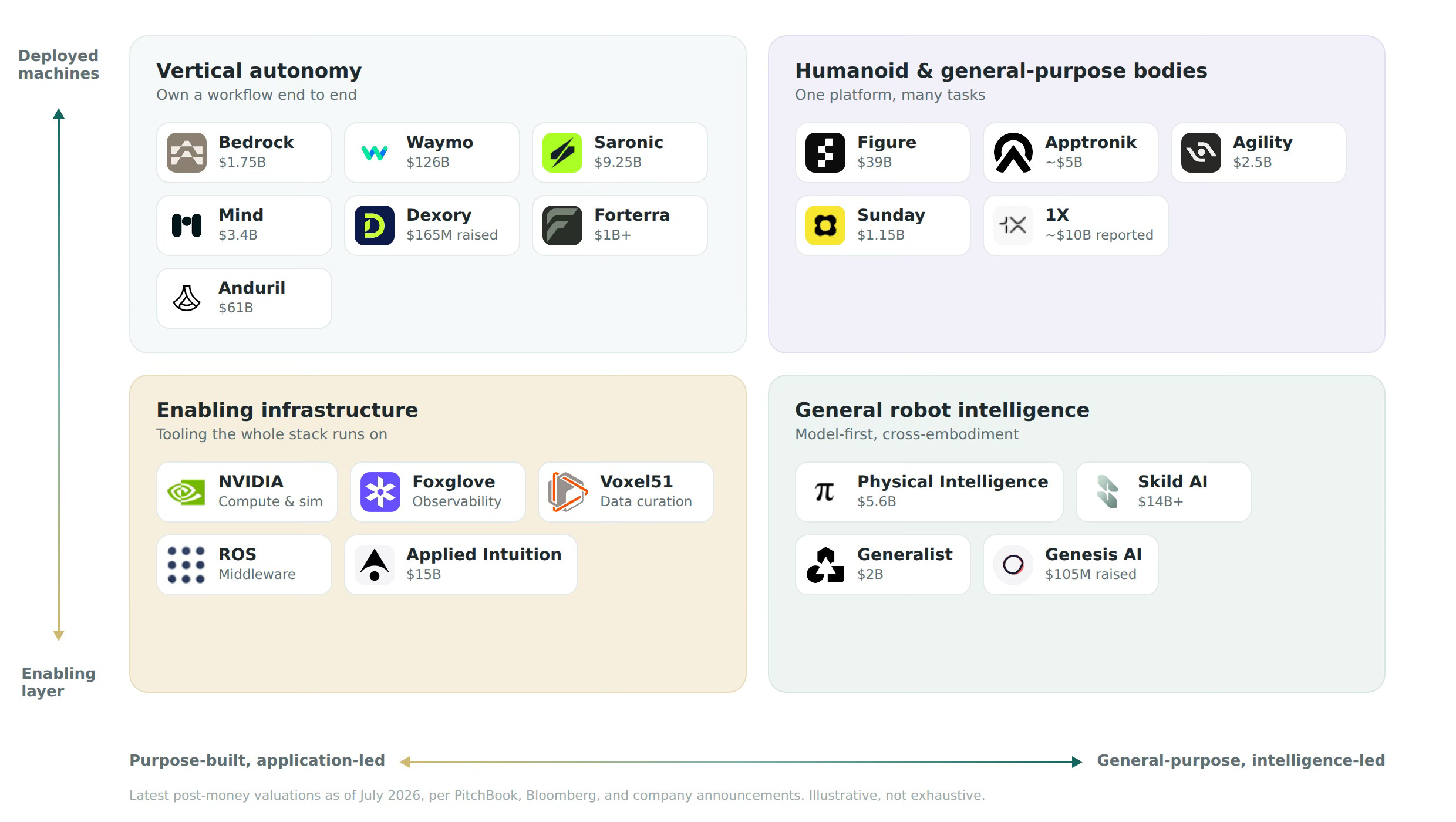
Players across the industry are pushing to build autonomy, but with differing approaches to the architecture. The core debates are generality versus specialization, horizontal versus vertical, model-first versus application-first, and data-first versus hardware-first.
Where value will accrue and what I’m watching
My current view is that value will concentrate around four control points:
Distribution into mission-critical workflows. The winners will be embedded in high-value customer workflows and integrated into existing systems, not simply offering the best autonomy model. Customers ultimately optimize for uptime, throughput, safety, and completed work, not intelligence in isolation. Distribution and workflow ownership become the path to durable adoption.
Proprietary experience loops. The moat comes from closed-loop learning across deployments. The most valuable data connects observations, actions, and outcomes across environments, particularly around interventions, failures, recoveries, and edge cases. Scale alone is not enough. Differentiated, high-quality operational data compounds with every deployment.
Deployment infrastructure and operations. As heterogeneous robotic fleets become commonplace, a horizontal operating layer will emerge for fleet management, observability, evaluation, remote intervention, safety, compliance, and orchestration across machines. Just as cloud infrastructure abstracted distributed computing, robotics infrastructure can abstract deployment and operations across diverse hardware platforms.
Full-stack deployment economics. Companies that control the software stack, from autonomy models and runtime to hardware integration and field operations, can optimize cost per productive hour. Commercial models such as Robotics-as-a-Service, leasing, and outcome-based pricing convert upfront capital expenditures into predictable operating costs while aligning vendor incentives with customer ROI.
The future favors vertical systems that own deployment and data, alongside a smaller number of horizontal model and infrastructure platforms that become standards.
The next phase will be less about viral demos and more about operating metrics. Robotics will be evaluated based on key metrics – i.e., intervention rates, cost per productive hour, fleet-learning speed, safety validation, data ownership, field service, etc.
The robots I imagined in 2008 looked like finished products. The reality is more interesting. Physical AI is emerging as a stack, an ecosystem, and a new operating model for industries where work happens through atoms rather than pixels. The winners will turn intelligence into reliable deployment, then turn deployment into data, learning, and better economics.
If you’re building at any of these control points - or have any feedback - I’d love to hear from you!